The Standards and Frameworks Behind TAOS
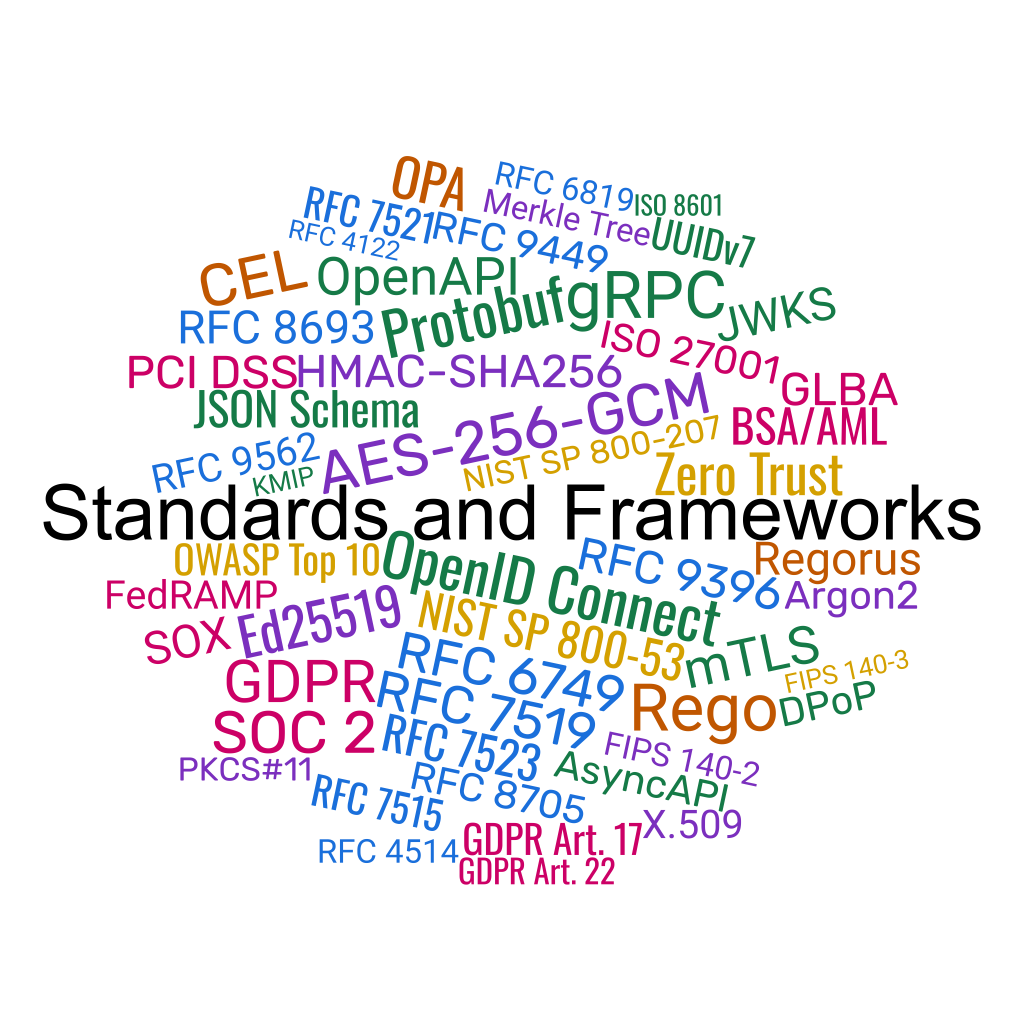
When we built TAOS, we didn't invent a new security model — we assembled the right existing ones. Every item in that word cloud is something TAOS implements, enforces, or emits as a first-class artifact. That's a deliberate choice.
Cryptography and identity
At the core are the primitives that everything else depends on. AES-256-GCM encrypts the vault — the store where credentials and secrets live, never exposed to tool servers directly. HMAC-SHA256 signs outbound callbacks so the control plane can verify they came from the kernel. Ed25519 signs daily Merkle audit seals. Argon2 (specifically Argon2id) is the KDF for any human-supplied passphrase; PKCS#11 is the interface we use to reach HSMs where required.
For identity tokens, TAOS follows RFC 8693 (Token Exchange) to mint On-Behalf-Of tokens that carry the full principal chain — who originally authenticated, on whose behalf the AI is acting, and which execution it belongs to. JWKS (RFC 7517/7519/7523) is how we publish and validate public keys. DPoP (RFC 9449) binds tokens to a specific key pair so stolen bearer tokens are useless. mTLS handles service-to-service channels where mutual certificate authentication matters.
Policy and authorisation
Zero Trust isn't a marketing term here — TAOS enforces it structurally. No agent call reaches a tool without a policy check. Rego (the Open Policy Agent policy language) is what those checks are written in; we run it embedded in Rust via Regorus so there is no OPA sidecar to manage or secure. CEL (Common Expression Language) drives workflow guard conditions — transition logic that is evaluated, not hard-coded.
OpenID Connect and its underlying OAuth 2 / RFC 6749 / RFC 9396 family govern how users authenticate and how scopes are delegated. RFC 9562 (UUIDs v7) gives every execution, step, and audit record a time-sortable identifier.
Compliance frameworks
TAOS is built to generate compliance evidence, not just to behave correctly in a demo. The audit layer emits records that map to controls in SOC 2, GDPR (Articles 17 and 22 — the right to erasure and automated-decision accountability), GLBA, BSA/AML, PCI DSS, HIPAA, FedRAMP, and FIPS 140-2/3. Policy bundles can be scoped to match NIST SP 800-53 and NIST SP 800-207 (Zero Trust Architecture) control families. ISO 27001 information-security controls and ISO 8601 timestamps round out the baseline.
Protocols and wire formats
gRPC with Protobuf is the internal backbone — typed contracts between the kernel, control plane, and SDK adapters. OpenAPI describes the REST surface. AsyncAPI documents the event streams. JSON Schema validates workflow inputs and outputs at the kernel boundary before any step runs. RFC 4514 (LDAP Distinguished Names) is how principals are represented inside tokens — stable, scoped, unambiguous.
Why it matters
Every one of these standards exists because someone, somewhere, learned something the hard way. TAOS is an opinionated assembly of those lessons applied to the specific problem of running AI agents in environments where correctness and auditability are not optional. The word cloud isn't a badge collection — it's a map of the constraints we accepted so you don't have to rediscover them.
If you want to understand how any of these fit together in practice, the architecture overview walks the full stack.
See these principles in practice
TAOS is the control plane we wish had existed.